TL;DR
This article is not about “which API is cheaper,” but about AI Tokens becoming the settlement unit for model capacity—and who will manage the gateway, routing, ledger, quality, and responsibility. Core judgment: Model reselling is not the endgame; model capacity operators are the long-term direction. Gray-market reselling will recede, but unified APIs, multi-model routing, semantic caching, compliance auditing, enterprise governance, and cost optimization will remain. The future competition will not be about “how many models you can access,” but whether you can operate model capacity into stable, trustworthy, deliverable, auditable, billable, and accountable results.
Introduction: Don’t Just See Model Reselling as a Cheap API Business#
Recently, model proxies, API relays, token agents, and unified API platforms have suddenly become very popular.
At first glance, many people see it as a “cheap API business”: someone bundles OpenAI, Claude, Gemini, DeepSeek, Qwen, Kimi and other models behind a single interface, then sells access at a lower price. Users don’t need to register on multiple platforms, manage dozens of API keys, or study each model’s pricing rules—just top up one balance and call many models.
On the surface, this looks like gray-market reselling, shell forwarding, and low-price arbitrage.
But if you only see it as a short-term cheap business, you underestimate the industrial shift behind it.
My judgment is: The chaos of model proxies, API relays, and token agents is the early-stage disorder of the market after AI Tokens became the settlement unit for model capacity. Gray-market reselling will recede, but unified gateways, multi-model scheduling, unified billing, cost governance, compliance auditing, and capability packaging will not disappear. They will continue to evolve and eventually give birth to a new industrial role: the Model Capacity Operator.
A Model Capacity Operator is not a simple API reseller, nor does it necessarily own the strongest models. What it truly operates is the gateway, metering, routing, ledger, quality, compliance, and responsibility boundaries of model capacity.
Next, the article follows a central thread: first, where today’s chaos comes from; then, why AI Tokens become the underlying settlement unit; followed by seven analogies to understand its future trends; and finally, why Model Capacity Operators will emerge, how they will evolve, and how different roles should respond.
You can think of the rest as nine consecutive questions:
- What is the current chaos of model proxies, API relays, and token agents?
- Why did they emerge, and what business models and gray/black risks lie behind them?
- Why is AI Token becoming the underlying settlement unit for model capacity?
- How can seven resource analogies help understand the future of AI Tokens?
- What do these seven analogies together point to regarding Model Capacity Operators?
- What are the capability boundaries, business models, and reasons for the emergence of Model Capacity Operators?
- What development trends will model capacity operations face next?
- How should individual users, developers, enterprises, and entrepreneurs respond?
- Finally, how should we judge this industry trajectory?
1. Current State: The Chaos of Model Proxies, API Relays, and Token Agents#
The most obvious feature of today’s model relay market is: demand is real, but forms are chaotic.
On one side, users really need a unified gateway.
Individual users want to spend less, developers want fewer SDKs to integrate, and enterprises want unified management of model calls. Everyone wants one account, one balance, one API, and one bill to call multiple models simultaneously.
On the other side, the supply side is very rough.
Many model proxy platforms claim to support dozens or even hundreds of models, with prices much lower than official ones, interfaces compatible with OpenAI format, and immediate availability after top-up. They solve some real pain points, but also bring many problems:
- Upstream model sources are opaque;
- Whether authorization is obtained is unclear;
- Whether gray key pools are used is unclear;
- Whether shared accounts, promo arbitrage, or stolen credits are involved is unclear;
- Whether the model users call is actually the real model is unclear;
- Whether expensive models are replaced by cheaper ones is unclear;
- How many layers of proxy the request passes through is unclear;
- Whether data is recorded, stored, trained on, or reused is unclear;
- Whether the platform has SLA, audit, compliance, and responsibility commitments is unclear.
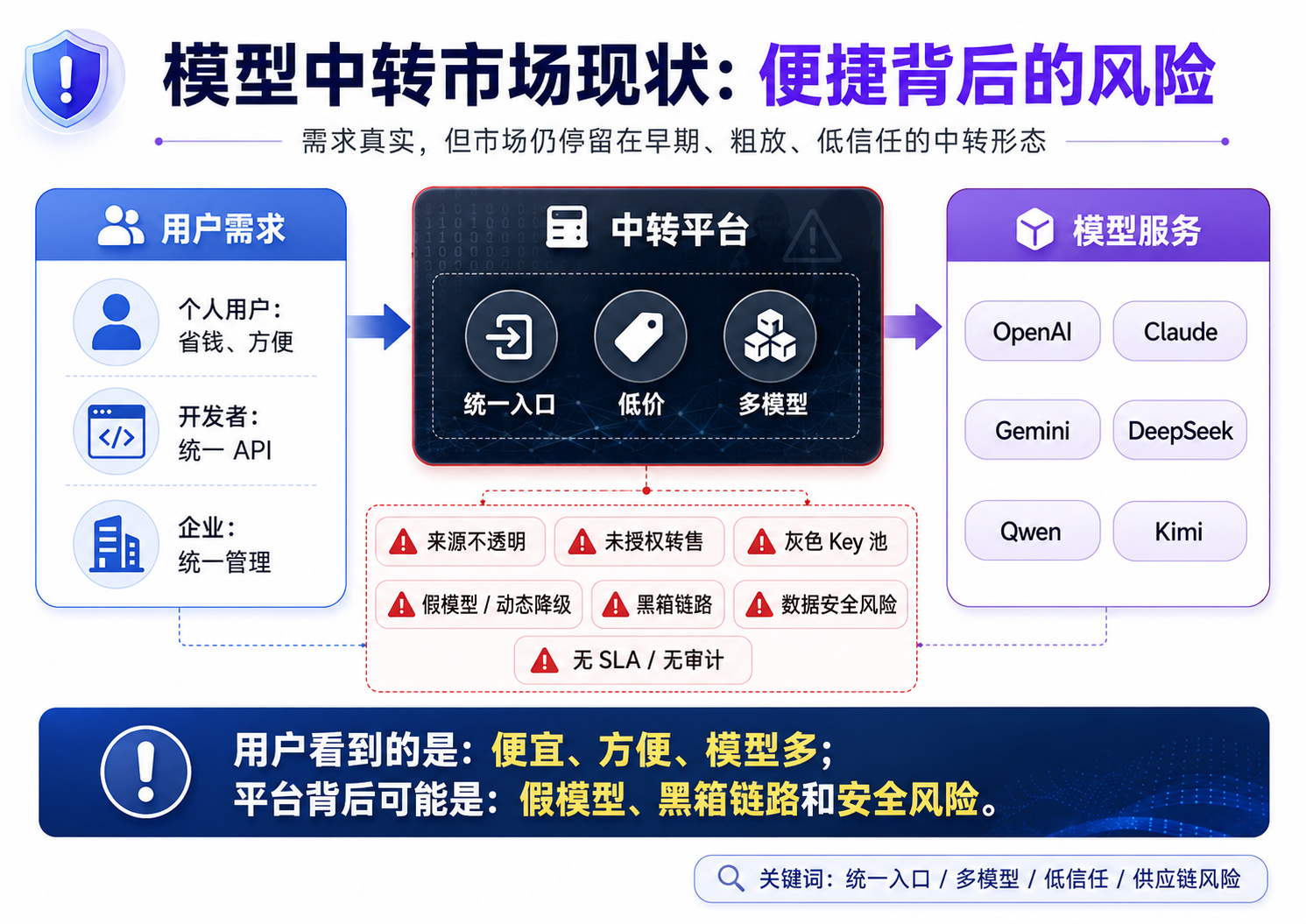
This is the most typical chaos of today’s model proxies, API relays, and token agents:
What users see: cheap, convenient, many models.
What may be behind the platform: gray key pools, unauthorized resale, fake models, black-box pipelines, and security risks.
The “fake model” problem, in particular, will become increasingly serious.
Users see the interface returning gpt-4, claude, gemini, or some expensive model name, but whether it’s actually that model is hard for ordinary users to verify. Some platforms may use cheap models to impersonate expensive ones, use distilled models to impersonate original ones, use local models to impersonate official ones, or even dynamically downgrade during peak hours.
This kind of risk is not simply about “a bit more expensive or cheaper”—it’s about the authenticity of model capability.
If users are just using it for casual chat, the problem is not serious. But once it enters code generation, contract review, financial analysis, enterprise knowledge bases, automated agents, or internal tooling, this black-box relay layer becomes a supply chain risk point.
So today’s chaos can be summed up in one sentence:
Demand has already emerged, but the market is still in an early, rough, low-trust relay form.
This is not the endgame, but a transitional phase.
2. Why Did It Emerge: Demand, Business Models, and Gray/Black Risks Converging#
Why did model relays, API relays, and token agents emerge? It can’t be explained by “people being cheap” alone.
Behind it are at least three forces: real demand, commercial arbitrage, and gray/black risks.
1. Real Demand: Too Many Models, Too Fragmented Interfaces#
Today, a developer or enterprise wanting to use large models faces not just one supplier, but a long list: OpenAI, Anthropic Claude, Google Gemini, DeepSeek, Qwen, Kimi, Zhipu, MiniMax, Volcano Ark, Alibaba Cloud Bailian, Tencent Cloud, Huawei Cloud, AWS Bedrock, Azure AI Foundry, Google Vertex AI, plus various open-source and self-hosted models.
Each platform has its own API format, authentication method, model names, pricing, context length, rate limits, error codes, SDKs, data policies, and compliance requirements.
If you’re just experimenting individually, this complexity is tolerable. But once you enter development and production environments, the problems become very real:
- Should a product integrate multiple models at once?
- If the primary model fails, should it automatically switch to a backup?
- If a task is simple, can it automatically use a cheaper model?
- If a user uploads sensitive data, should it use a private or trusted cloud model?
- If a department exceeds budget, can it be rate-limited?
- If the boss asks how much the company spent on AI this month, can you give a clear answer?
So what users truly need is not the “relay” form itself, but:
One account, one balance, one API, one bill, one routing strategy.
In the early single-model era, the problem was simple: get a key, write a prompt, send a request, get a result.
The multi-model era is different.
Different models suit different tasks. Simple Q&A can use cheap, fast models; translation, summarization, rewriting can use cost-effective general models; complex reasoning needs stronger models; code tasks need models strong at coding; long-document processing needs long-context models; images, audio, video need multimodal models; enterprise private data may need self-hosted models; legal, medical, financial scenarios need vertical industry models.
So the question is no longer:
Which model is the best?
But rather:
Which model is most suitable for this current task?
That’s the value of model routing and unified APIs.
Going deeper, AI workloads are different from traditional web APIs. Traditional API requests usually have predictable costs, short responses, and light state; but model requests can consume large amounts of context at once, return long streaming responses, and encounter rate limits, queuing, 429 errors, latency jitter, and service degradation under high concurrency. More troublesome is that underlying model capabilities are highly heterogeneous: the same question given to different models yields different costs, speeds, quality, compliance risks, and responsibility boundaries.
This forces the relay layer to upgrade from a “passive forwarding channel” to an “active management pipeline”: inbound needs identity, permissions, budget, sensitive data, and prompt injection checks; outbound needs content safety, logging, auditing, watermarking, quality observation, and responsibility attribution. In other words, production-grade AI infrastructure naturally pushes simple API relays toward more complex model capacity operations.
2. Current Business Models: Low-Price Arbitrage, Unified Gateway, and Balance Pools#
Today, many model relay platforms have relatively early-stage business models, mainly in several categories:
The first is low-price arbitrage. Platforms obtain lower upstream costs through bulk purchasing, promotional credits, regional price differences, account systems, or other means, then sell to users at prices lower than official but higher than their own costs.
The second is prepaid balances. Users top up first, and the platform deducts based on token consumption. Simple for users, forming a balance pool and cash flow for the platform.
The third is unified API. Platforms package multiple models into a unified interface, allowing developers to call multiple models with one format.
The fourth is multi-model packages. Platforms bundle different models into memberships, credit packs, monthly packs, and team packs, so users don’t have to study price tables one by one.
The fifth is enterprise usage packs. Targeting teams or enterprises, providing budgets, billing, sub-accounts, statistics, rate limiting, logging, and other basic capabilities.
These models themselves are not necessarily problematic. The problem is: if the platform has no authorization, no transparent upstream, no security commitments, no audit capabilities, no content watermarking, and no responsibility boundaries, it easily slides into gray or even black chains.
3. Non-Compliance, Risks, and Gray/Black Factors#
The risks of the model relay layer are mainly concentrated in several areas.
First, unauthorized resale. Many model service terms do not allow users to resell API keys. If a platform doesn’t have upstream authorization, it may essentially be doing unauthorized distribution.
Second, gray key pools. Platforms may pool a large number of personal accounts, student credits, trial credits, promotional credits, stolen accounts, or keys of unknown origin, then sell them externally. Such models may have very low prices, but stability, legality, and security are all poor.
Third, fake models and model downgrading. Platforms may claim to call an expensive model but actually use a cheap model, distilled model, or other substitute. Users have a hard time proving whether they’re getting the target model.
Fourth, data leakage. Users may send code, contracts, customer information, enterprise data, database queries, internal API parameters, and agent tool call traces to the relay station. If the relay station has no clear data processing agreement, no security commitment, and no audit mechanism, the risk is very high.
Fifth, Shadow AI. Employees privately purchase API keys, upload corporate data, connect external agents, and link business systems to untrusted models, creating invisible, unmanageable, unauditable AI usage chains within the organization.
Sixth, the Agent era will amplify supply chain risks. In the past, relay stations mainly saw prompts. In the future, agents will call tools, read files, access databases, connect to MCP servers, call internal APIs, and even process credentials and business system results. At this point, the relay layer is no longer just a “text forwarder” but could become a supply chain attack point.
Seventh, regulation will increasingly focus on model sources, content watermarking, responsibility for generated content, data cross-border transfers, security assessments, algorithm filing, and call chain auditing.
When model sources need to be explained, generated content needs to be watermarked, and call chains need to be audited, black-box relays will find it hard to survive long-term.
So my judgment is:
Gray-market relays will be compressed, but model aggregation will not disappear.
What disappears is opaque, unaccountable, unauditable black-box relays.
What remains is unified gateways, multi-model scheduling, unified billing, enterprise governance, cost optimization, compliance auditing, and industry capability packaging.
3. Underlying Factor: AI Token Is Becoming the Settlement Unit of the AI Era#
Why do model relays revolve around tokens? Why must all API platforms eventually deal with billing, settlement, packages, cost attribution, and usage management?
The underlying reason is: AI Token is becoming the most important settlement unit of the AI era.
It was originally a technical concept in NLP, representing the basic fragment of text processed by a model. But in the commercial era of large models, AI Token is no longer just a text slice—it’s the common unit connecting model capability, user tasks, supplier costs, and platform ledgers.
In the past, we might only care about input tokens and output tokens. Now we also need to consider cached input, reasoning tokens, long context tokens, vision tokens, audio tokens, video tokens, tool-use tokens, and agent step tokens.
For the same 1 million AI Tokens, different models can have vastly different prices; within the same model, input and output prices differ; cache hit and miss prices differ; normal and reasoning modes differ; long context, multimodal, low latency, high reliability all change the price.
More precisely, AI Token is evolving from a technical measurement unit into a “cognitive load” measurement unit in AI-native services.
In the traditional internet, users care about bandwidth, latency, and packet loss. In AI services, new experience metrics become:
- Time-to-First-Token (TTFT)
- Tokens per second (TPS)
- Context length
- Cache hit rate
- Cost per Token
- Tokens per Watt
- Task success rate
- Cross-agent settlement accuracy
- Goodput: effective output meeting latency SLO
This means that in the future, measuring whether an AI service is good depends not just on “whether the interface works,” but on whether it can stably, with low latency and low cost, generate sufficiently high-quality AI Tokens and ultimately complete user tasks.
But here’s an important boundary: users don’t actually care about AI Tokens themselves.
What users care about is:
- Can this code be written well?
- Can this document be summarized?
- Can this contract be reviewed?
- Can this customer service issue be resolved?
- Can this agent run through tasks stably?
- Can this professional advice be verified and held accountable?
AI Token is the underlying consumption unit, but what users ultimately buy is the result.
Just as ordinary users don’t care how many data packets are used behind a video call—they only care if the call is smooth—future AI users won’t constantly worry about how many tokens they’ve consumed, but rather: how much does a task cost? Is the result good? Is it stable? Who’s responsible if something goes wrong?
So the industrial significance of AI Token is:
For model vendors, it’s the unit of inference cost.
For platforms, it’s the unit of ledger and settlement.
For enterprises, it’s the unit of cost governance.
For users, it will ultimately be packaged into plans, task packs, and outcome-based pricing.
This is the foundation for all the analogies that follow.
However, AI Token cannot simply be equated to traffic, compute, or electricity.
The most important sentence is:
Mobile data transfers information; AI Tokens generate judgments.
Behind AI Tokens are not ordinary data packets, but answers, code, plans, suggestions, judgments, and even action instructions. Once they enter enterprise workflows, financial risk control, legal review, medical assistance, and automated agents, it’s not just about “whether the call succeeded,” but “whether the result is reliable, explainable, auditable, and accountable.”
4. Future Trends of AI Tokens: A Framework of Seven Analogies#
This section has the highest information density in the entire article. To avoid reader fatigue from diving straight into lengthy analysis, here’s a diagram laying out the seven analogies first:
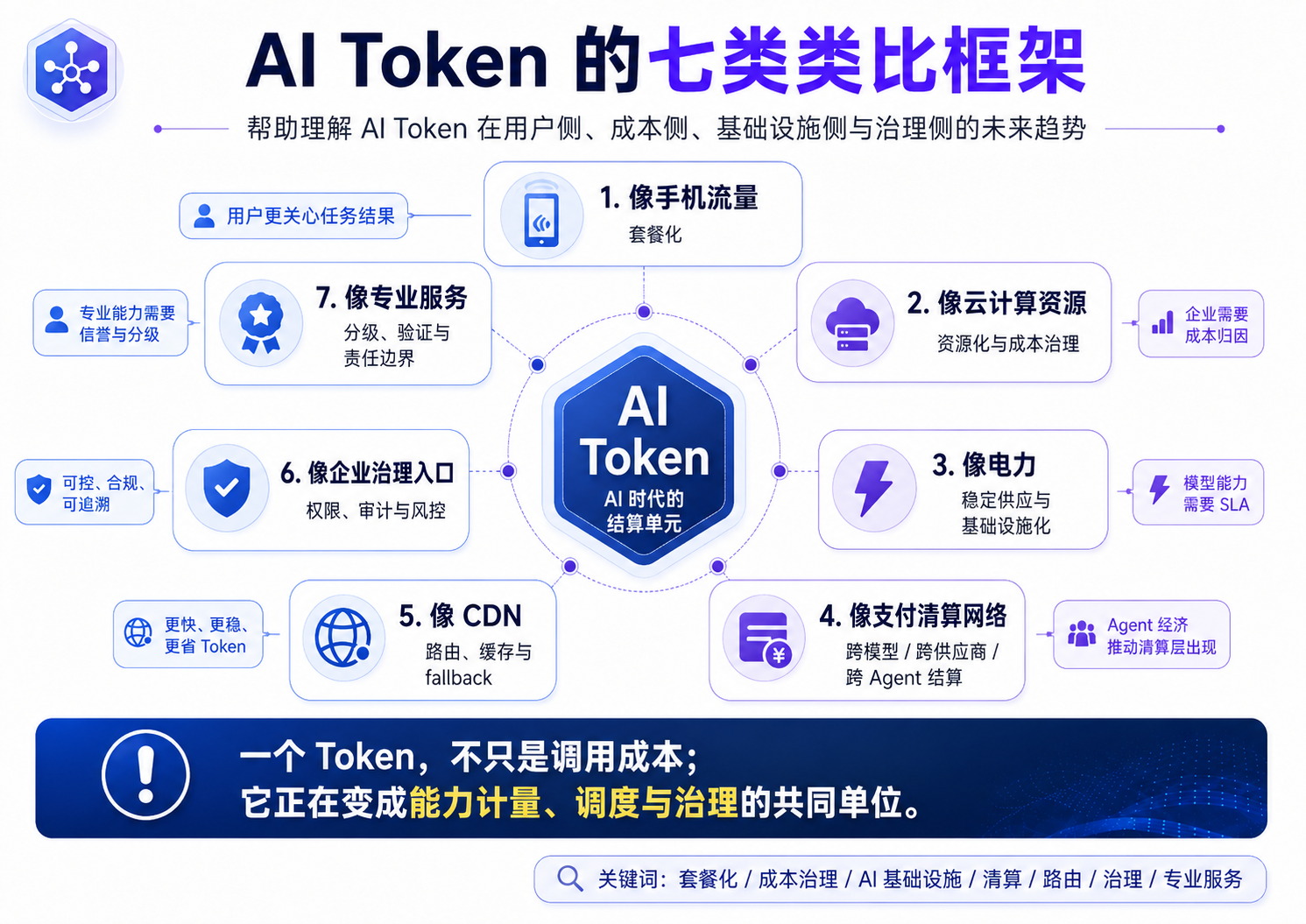
Here’s a summary table for quick reference:
Summary Table of Seven Analogies for AI Token Future Trends#
| # | Analogy | Corresponding Trend | What to Remember |
|---|---|---|---|
| 1 | Mobile Data | Plans, credit packs, task packs | Users won’t just care about unit price, but about “is it enough, will I exceed, can I share” |
| 2 | Cloud Computing | Cost governance, budget attribution, elastic scaling | Enterprises will manage AI Token costs like they manage cloud costs |
| 3 | Electricity | Stable supply, redundancy, SLA/SLO | Model capability will go from “can call” to “must be stably supplied” |
| 4 | Payment Clearing Network | Cross-model, cross-supplier, cross-agent settlement | Multi-model era needs ledgers, reconciliation, profit sharing, and dispute resolution |
| 5 | CDN | Routing, caching, fallback | Requests will be dynamically distributed to the most suitable model, not always hitting a single model |
| 6 | Enterprise Governance Gateway | Permissions, audit, risk control, compliance | Enterprises need to know who is using which model, spending how much, and where data goes |
| 7 | Professional Services | Tiering, verification, responsibility boundaries | General tokens will be cheap; professional tokens will command a premium due to result quality and accountability |
How to read this table: These 7 analogies don’t replace each other; they explain 7 different facets of AI Tokens. Together, they point to the core role in the following section: the Model Capacity Operator.
To understand the future of AI Tokens, I think seven analogies are useful.
These analogies are not meant to say AI Token is completely equivalent to some old resource, but to explain its different trends on the user side, cost side, infrastructure side, settlement side, scheduling side, organizational governance side, and professional service side.
1. Like Mobile Data: Plans#
From the user’s perspective, AI Token is most like mobile data.
The telecom industry once shifted from “charging by minutes and SMS” to “charging by data plans.” Behind this was the shift from circuit-switched to packet-switched networks, with the unit of measurement changing from connection duration to data packets and GB.
The AI industry is undergoing a similar transition: applications are no longer just charging by software seat or subscription period, but increasingly organizing business models around AI Token consumption, Time-to-First-Token, Token throughput, and task results.
Mobile data has gone through: Per MB billing → Monthly plans → Large data plans → Unlimited plans → Family sharing / Enterprise dedicated lines
AI Tokens may also go through: Per million tokens → Monthly token packs → Team shared credits → Agent call packs → AI office suites → Industry task packs
Ordinary users won’t care about the price per million AI Tokens for long. They care more about: Is my plan enough? Can this task be completed? Is the result stable? What happens if I go over?
So on the user side, the first thing future platforms must do is translate complex model calls into understandable credits, plans, balances, task packs, and outcome-based prices.
But the boundary is also clear:
Mobile data transfers information; AI Tokens generate judgments.
Mobile data mainly solves connectivity; AI Tokens also affect answers, decisions, transactions, code, contracts, organizational processes, and automated actions.
2. Like Cloud Computing: Resourceization and Cost Governance#
In front of users, AI Token is like data; in the ledgers of platforms and enterprises, AI Token is more like cloud resources.
Cloud computing features on-demand, elastic, resource pooling, pay-per-use, observable, and optimizable.
AI Token will enter a similar cost governance system:
- Which department used how many AI Tokens?
- Which project burns the most money?
- Which tasks are suitable for caching?
- Which tasks can use cheap models?
- Which calls need strong models?
- What’s the cost per API call?
- What’s the AI cost per customer, per order, per task?
In the future, enterprises will do AI cost governance the same way they do cloud cost governance.
This is why Cost per Token becomes increasingly important. In the past, when enterprises purchased compute, they looked at GPU models, FLOPS, VRAM, and rental unit price; but what large model inference actually delivers to business is not FLOPS, but usable AI Tokens.
A more expensive new piece of hardware, if it generates more AI Tokens per second, more AI Tokens per watt, and lower cost per million AI Tokens, might actually be the cheaper choice.
From this perspective, data centers will increasingly become “AI Token factories”: raw materials are electricity, chips, model weights, and data; output is intelligent tokens consumable by applications.
A platform’s cost advantage isn’t just buying cheap APIs, but combining underlying compute, caching, batch processing, local models, private models, and cloud models into the lowest unit AI Token cost.
We’ll also see “Model-as-a-Service” architectures where high-frequency, routine, sensitive, or low-complexity inference tasks can be offloaded to local or private cloud models, while complex, low-frequency, heavy reasoning tasks go to cloud large models. Otherwise, if enterprises put all automated workflows on public cloud token-metered interfaces, the efficiency gains from AI may be eaten up by continuously growing inference bills, creating structural profit leakage.
3. Like Electricity: Stable Supply and Infrastructuralization#
When AI penetrates office work, customer service, R&D, finance, healthcare, and government, model capability will become infrastructure, like electricity.
Today’s software systems can function without AI, but in the future, many software systems, employees, devices, and workflows may continuously call models.
At that point, users will care about:
- Is it stable?
- Will it go down?
- Is there an SLA?
- Is there a backup model?
- Will it slow down during peak hours?
- Can responsibility be assigned if something goes wrong?
The platform’s value will upgrade from “low-price forwarding” to “stable supply of intelligent resources.”
Going further, model capability platforms may participate in building a distributed intelligent infrastructure similar to an AI Grid. The heaviest training and complex reasoning remain in centralized AI factories; regional computing centers handle city-level and industry-level inference loads; edge models on enterprise premises, base stations, and terminal devices handle local high-frequency tasks and personalized context.
The purpose is not to sound good conceptually, but to reduce latency, reduce redundant transmission, meet data residency requirements, and extend AI Token generation from a single cloud center to a more distributed intelligent network.
A point worth keeping from the reference material is that centralized cloud architecture will encounter physical and environmental limits. AI models are energy-intensive workloads, and power supply, chip shortages, cooling bottlenecks, and geopolitical factors will all constrain the infinite expansion of a single centralized cloud. A more sensible future form is not to route all data back to a central large model, but to push some “intelligent computing power” closer to where data resides: centralized AI factories handle the heaviest training and complex reasoning; regional computing centers handle daily high-intensity inference; small language models on enterprise premises, base stations, and terminal devices handle local context and high-frequency lightweight tasks.
But the boundary is:
Electricity is highly homogeneous; AI Tokens are highly heterogeneous.
The difference between electricity sources is limited, but AI Tokens from different models, tasks, and contexts have vastly different value.
Therefore, key metrics for AI infrastructure will shift from simply “how many GPUs” to “how many AI Tokens per watt,” “cost per million AI Tokens,” “whether stable supply is available during peak hours,” and “whether edge nodes can process local context.”
4. Like Payment Clearing Networks: Cross-Model, Cross-Supplier, Cross-Agent Settlement#
If a platform simultaneously connects dozens of model suppliers and serves thousands of enterprise customers, complex settlement problems arise.
Users see one account, one bill, one balance, but behind the scenes, multiple models, vendors, regions, and pricing systems may be invoked.
The platform must handle:
- Upstream model costs
- Downstream customer billing
- Department budgets
- Task attribution
- Refunds and disputes
- Cross-region, cross-currency, cross-supplier settlement
- Unified account balance
- Capability conversion between models
This is very similar to a payment clearing network.
But the boundary is:
Payment clearing networks explain cross-model conversion and unified accounts, but cannot account for model capability differences.
Money is highly standardized; AI Tokens are not. One million AI Tokens from a strong reasoning model and one million AI Tokens from a cheap chat model are not the same capability.
The Agent era will make this even more complex. In the future, a single task may be completed by multiple agents working together: one agent handles planning, one calls search, one calls code tools, one accesses the enterprise knowledge base, one calls a specialized model. They not only need to communicate but also settle the AI Tokens, tool calls, and service results each consumes.
Therefore, cross-model settlement in the future may not just be “giving the user a bill” but evolving into some kind of AI clearing house capability: recording which model, which agent, which tool each call came from, how many AI Tokens or task results were contributed, and how costs and revenues should be shared.
A2A, MCP, x402, machine-to-machine micropayments, stablecoin settlement, and other directions can all be seen as exploring the underlying settlement mechanisms of this Agent economy.
5. Like CDN: Routing, Caching, and Fallback#
CDN delivers content to nodes closer, faster, and cheaper to users, reducing latency and cost through caching, edge access, origin protection, and fallback.
Model capability platforms will do similar things on the scheduling side:
- Simple requests go to cheap models
- Complex requests go to strong models
- Repeated questions hit semantic cache
- Fallback when a model fails
- Dynamic routing based on latency, price, quality
- Model selection based on compliance requirements
In the future, model routing will become a basic capability, like today’s load balancing, CDN scheduling, and database read-write separation.
One of the most critical technologies here is semantic caching.
Traditional caching usually relies on exact URL, string, or hash matching; but in natural language, “what’s your return policy” and “how do I return an item” may be semantically the same question even if they look different.
An AI Gateway can first do fast exact matching, then use embedding and vector similarity for semantic matching: if confidence is high enough, directly return the cached answer, avoiding calling an expensive model again.
This brings three results: first, repeated requests no longer burn AI Tokens repeatedly; second, TTFT significantly decreases because many answers become cache reads; third, upstream model rate limit pressure drops, leaving truly expensive strong models for long-tail complex tasks.
But the boundary is:
CDN explains scheduling, caching, and fallback, but AI Token scheduling also involves semantic quality, security, compliance, and responsibility.
CDN schedules content delivery; AI Token scheduling involves generative judgment capability.
6. Like Enterprise Governance Gateway: Permissions, Audit, and Risk Control#
AI Token has another easily underestimated trend: it will enter the enterprise governance system.
Enterprises will not long allow employees to individually register model accounts, buy API keys, upload company data, connect external agents, or link business systems to untrusted models.
This is Shadow AI.
What enterprises truly need is a unified gateway: all model calls pass through here, where identity, permissions, budgets, audit, masking, logging, cost attribution, model whitelists, and compliance policies are managed.
Such systems will increasingly resemble a combination of API Gateway, IAM, FinOps, security gateway, and audit systems.
It typically provides:
- Unified API
- Key management
- Budget management
- Rate limiting
- Cost tracking
- Call logs
- Model routing
- Semantic caching
- Fallback
- Prompt guard
- Sensitive data filtering
- PII/DLP detection
- Prompt injection defense
- Content safety filtering
- Session-level context caching
- Audit and compliance policies
Enterprise AI Gateway is not technical pedantry, but the basic security infrastructure for organizational AI usage.
From this perspective, AI Token is not just a number on a bill, but the water meter, electric meter, main switch, and audit entry point of enterprise AI governance.
7. Like Professional Services: Tiering, Verification, and Responsibility Boundaries#
Finally, AI Token is also like professional services.
This is where the “traffic analogy” is most misleading.
General AI Tokens will become increasingly cheap. Tasks like simple Q&A, summarization, translation, rewriting, classification, information extraction, simple code completion, and lightweight RAG will continue to see price drops due to increased inference chips, model distillation, quantization, MoE, KV Cache optimization, prompt caching, and big-company price wars.
But professional AI Tokens won’t simply become commodity prices.
In legal, medical, financial, R&D, and government scenarios, what users buy is not simple inference compute, but industry corpora, professional knowledge, workflows, templates, verification mechanisms, risk warnings, audit trails, enterprise compliance, and responsibility boundaries.
So one sentence must be kept:
General tokens are like data; professional tokens are like expert services.
More bluntly:
1GB of data is largely still 1GB of data, but between 1 million tokens and 1 million tokens, there may be the difference between an expert and a parrot.
This also explains why AI Tokens won’t become completely homogeneous.
They may become cheaper in general scenarios while commanding high multiples in professional scenarios.
5. Aggregating the Seven Analogies: The Emergence of the Model Capacity Operator#
Putting the seven analogies together reveals the outline of a new role.
If you look only at the user side, it’s like mobile data: users need plans, credits, balances, shared packs, and overage billing.
If you look only at the cost side, it’s like cloud computing: platforms need cost attribution, elastic scheduling, cache optimization, budget control, and usage analytics.
If you look only at the infrastructure side, it’s like electricity: enterprises need stable supply, SLA, backup lines, failover, and responsibility tracking.
If you look only at the settlement side, it’s like a payment clearing network: multi-model, multi-supplier, multi-customer, multi-agent needs unified accounts, cross-model conversion, reconciliation, profit sharing, and dispute resolution.
If you look only at the scheduling side, it’s like CDN: platforms need to dynamically select models based on latency, price, quality, region, compliance, and failure status, using semantic caching and fallback to reduce cost and improve stability.
If you look only at the organizational side, it’s like an enterprise governance gateway: enterprises need permissions, budgets, audit, masking, logs, model whitelists, and compliance policies.
If you look only at the professional side, it’s like professional services: users need not just cheap tokens, but verifiable, deliverable, accountable professional results.
So the seven analogies ultimately point not to an abstract concept, but to a very concrete set of operational capabilities:
Plan design capability
- Token-native metrics management (TTFT/TPS/Cost per Token/Tokens per Watt)
- Cost governance capability
- Stable supply capability
- AI Grid / edge inference organization capability
- Cross-model settlement capability
- Inter-agent clearing capability
- Intelligent scheduling capability
- Semantic caching capability
- Enterprise governance capability
- Compliance audit capability
- Professional verification capability
- Result accountability capability
= Model Capacity Operator
This is what I call the Model Capacity Operator.
It’s not a simple API forwarder.
It doesn’t necessarily own models.
But it operates the gateway, metering, routing, ledger, quality, compliance, and responsibility boundaries of model capacity.
The following diagram breaks down the capability structure of the “Model Capacity Operator”: from infrastructure, to operational governance, to value delivery—the real moat is not how many models you can access, but whether you can operate model capacity into stable, trustworthy, and deliverable results.
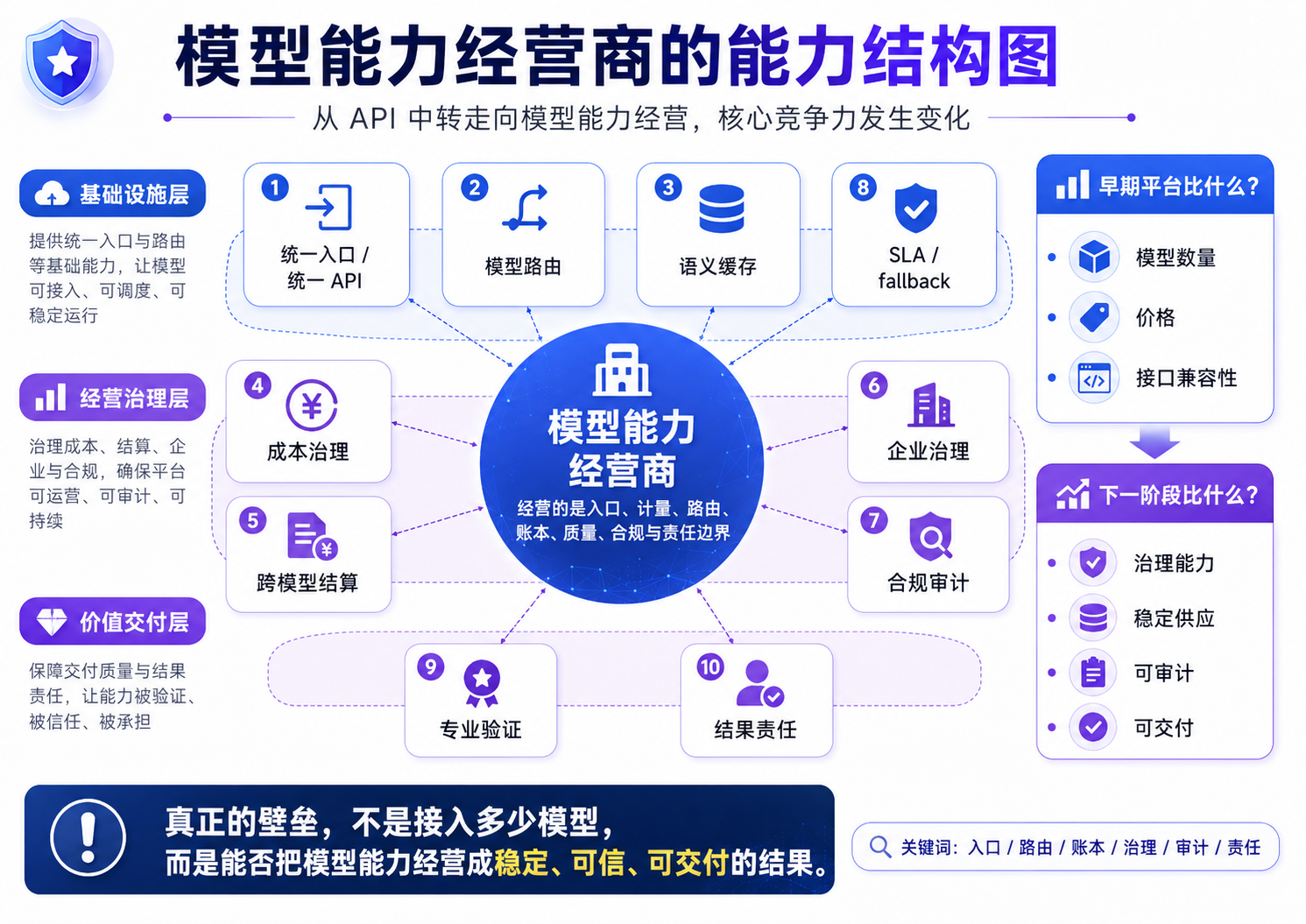
Early model relay stations competed on model count, price, and API compatibility. Whoever could offer more models, cheaper prices, and OpenAI API compatibility would attract developers more easily.
But the next stage will be about operational capability.
That is, the real question becomes:
Who has the ability to operate model calls—from individual API requests—into stable, trustworthy, deliverable, auditable, billable, and accountable model capacity?
This is the core reason why Model Capacity Operators will emerge.
6. Capability Boundaries, Business Models, and Why Model Capacity Operators Emerge#
After introducing the concept of the Model Capacity Operator, three questions remain: What can it do? What can’t it do? How does it make money?
1. Capability Boundaries: Can Operate Capacity, But Cannot Eliminate Responsibility#
Model Capacity Operators can do a lot.
They can provide a unified API, consolidating multiple models into a single gateway.
They can build an LLM Router that selects models based on task type, cost, latency, context length, data sensitivity, quality requirements, and compliance region.
They can implement semantic caching, so repeated or similar questions no longer burn AI Tokens repeatedly.
They can set up fallback, automatically switching to backup models when the primary model fails, hits rate limits, or degrades in quality.
They can perform cost attribution, allocating AI Token consumption to departments, projects, customers, orders, and tasks.
They can implement budget control, letting enterprises know who is spending money, where it’s going, and whether they’re over budget.
They can provide model whitelists, data masking, content safety, prompt injection defense, PII/DLP detection, RBAC, log retention, compliance auditing, and content watermarking.
They can also handle cross-model settlement, inter-agent settlement, refund dispute resolution, and supplier reconciliation.
It’s important to distinguish between model providers and Model Capacity Operators. Model providers are mainly responsible for foundational model training, parameter iteration, and base model capability. Model Capacity Operators are closer to system-layer deployment, governance, and stewardship—they integrate models into enterprise workflows and provide access control, audit logs, DLP, content watermarking, call records, and responsibility attribution. As regulations in different regions increasingly differentiate between roles like provider, deployer, and distributor, this boundary will become even more important.
But Model Capacity Operators also have limits.
They cannot guarantee that all model outputs are absolutely correct.
They cannot evade all responsibility by claiming “I’m just a relay.”
They cannot package opaque model sources as a low-price advantage.
They cannot treat high-risk professional tasks as simple general chat.
They cannot hide enterprise data security, compliance auditing, and content responsibility inside a black box.
More importantly, they must acknowledge:
Behind every AI Token is a judgment, and judgments carry quality, risk, and responsibility.
So the capability boundary of a Model Capacity Operator is not “how many models I can access,” but “to what extent I can make model capacity controllable, auditable, billable, deliverable, and accountable.”
2. Possible Business Models#
Model Capacity Operators may have multiple business models in the future.
First, AI Token packs. This is closest to today’s relay model: users purchase credits and are deducted based on consumption. The difference is that platforms that survive long-term must have upstream authorization, genuine models, transparent billing, and data security.
Second, enterprise model gateway subscription. Enterprises purchase AI Gateway capabilities on a monthly or yearly basis, including unified gateway, permissions, budgets, logs, audit, model whitelists, masking, routing, and compliance policies.
Third, task-based pricing. Users no longer buy AI Tokens directly, but purchase task results—such as document processing, customer service tickets, code review, contract review, knowledge base Q&A, and automated agent execution.
Fourth, industry task packs. Targeting legal, medical, financial, education, and government scenarios, packaging model calls, industry knowledge, templates, verification mechanisms, and audit trails into professional services.
Fifth, private deployment, sovereign cloud, and hybrid cloud services. Enterprises place sensitive tasks on local, private, or sovereign cloud infrastructure, while complex low-frequency tasks go to cloud-based strong models. The platform handles unified scheduling and cost governance. For multinational enterprises, finance, government, and healthcare scenarios, data residency, access control, audit evidence, and supply chain explainability themselves become reasons to pay.
Sixth, cost optimization revenue sharing. Platforms help enterprises reduce AI Token costs through semantic caching, model routing, batch processing, context compression, and local model substitution, then share in the savings.
Seventh, compliance audit and content watermarking services. When regulations require traceability of model sources, generated content, data processing, and call chains, audit capability itself becomes a product.
Eighth, Agent invocation and clearing services. When multiple agents, models, and tools work together on a task, the platform can provide call records, cost allocation, revenue settlement, dispute resolution, and responsibility tracking.
Ninth, multi-layer platform and professional services. Mature platforms won’t rely solely on API price arbitrage. They may form a combination of IaaS, PaaS, SaaS, and professional services: the bottom layer provides GPU or inference resources; the middle layer provides LLM interfaces, fine-tuning environments, model gateways, and development platforms; the top layer provides white-label enterprise Copilot, no-code AI building tools, industry agents, and algorithm marketplaces. Revenue will also expand from simple pay-per-use to subscriptions, revenue sharing, private deployment, custom development, and compliance consulting.
3. Why This Role Must Emerge#
The Model Capacity Operator is not a concept pulled from thin air, but the result of multiple converging pressures.
First, the number of models keeps growing, and users cannot manage all of them themselves.
Second, model pricing is becoming increasingly complex, and users cannot study price tables every day.
Third, enterprise AI usage is becoming ubiquitous, and organizations must govern Shadow AI.
Fourth, AI Token costs will shift from technical costs to financial costs—enterprises need budgeting, attribution, and optimization.
Fifth, agent call chains will grow longer, with a single task potentially spanning multiple models, tools, knowledge bases, and external services.
Sixth, regulation will increasingly focus on data, content, model sources, and call chains.
Seventh, what users ultimately want to buy is task results, not underlying AI Tokens.
Therefore, in the long run, the model call market will not stay at “who sells cheaper.”
It will move toward “who can operate model capacity more stably, more compliantly, at lower cost, with better scheduling, clearer settlement, and greater accountability.”
7. Development Trends of Model Capacity Operations#
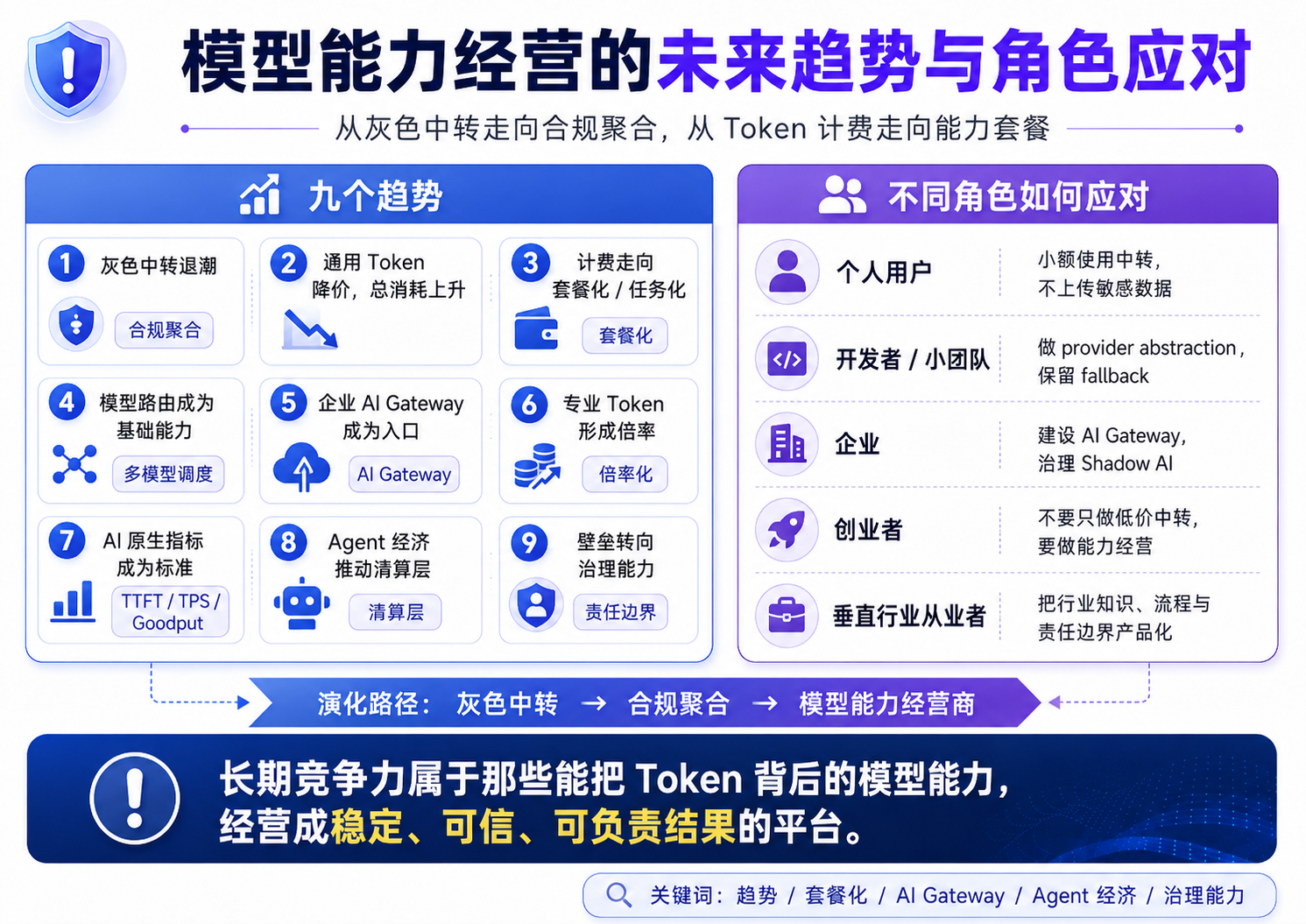
Following this line of reasoning, I believe model capacity operations will exhibit nine trends.
1. Gray-Market Relays Recede, Compliant Aggregation Rises#
Platforms relying on gray key pools, unauthorized resale, fake models, opaque proxies, no data agreement, and no audit capabilities will find it increasingly difficult to survive.
But authorized API aggregation platforms, cloud vendor model platforms, enterprise AI Gateways, and industry capability platforms will become increasingly important.
In short:
Gray-market relays will be compressed, but model aggregation will not disappear.
2. General AI Token Unit Price Drops, But Total Consumption Rises#
General AI Tokens will continue to get cheaper.
Reasons include increased inference chips, model distillation, quantization, MoE, KV Cache optimization, open-source model catch-up, prompt caching, and big-company price wars.
But total consumption won’t necessarily decline.
Because agents will automatically break down tasks and call models in multiple rounds; long contexts will increase input; RAG will stuff in large amounts of background material; multimodality will process images, audio, and video; tool calls will add steps; multi-agent collaboration will amplify call volume.
So the future may present a seemingly contradictory phenomenon:
Each token is cheaper, but each task consumes more tokens behind the scenes.
3. Pricing Moves from Pay-Per-Use to Plans and Task Packaging#
Today, everyone is still comparing prices per million AI Tokens.
In the future, it’s more likely to become: AI office plans, code assistant plans, agent call packs, enterprise knowledge base plans, document processing packs, after-sales diagnostic task packs, and industry model service packs.
What users ultimately care about is not token unit price, but:
- How much does task completion cost?
- Can it be completed reliably?
- Is the quality dependable?
- Is it auditable?
- Who is responsible if something goes wrong?
This will transform AI Tokens from “pay-per-use resources” into “capability packages.”
4. Model Routing Becomes a Foundational Capability#
Future AI applications will not be tied to a single model, but connected to a model capability pool.
Systems will automatically select models based on cost, latency, accuracy, context length, multimodal capability, data sensitivity, compliance region, and fallback requirements.
Simple tasks use cheap models, complex tasks use strong models; public data uses public models, sensitive data uses private models; when the primary model fails, automatically switch to a backup.
Model routing will become as foundational as today’s load balancing, CDN scheduling, and database read-write separation.
5. Enterprise AI Gateway Becomes the Organizational AI Access Point#
Enterprises will increasingly care about the AI call gateway.
It needs to centrally manage identity, permissions, budgets, model access, logs, audit, sensitive data, cost attribution, fallback, and compliance policies.
Without this gateway, a large amount of Shadow AI will emerge within organizations: employees buying their own keys, uploading their own data, connecting external tools, and sending business data to unknown models.
This is unmanageable for enterprises.
6. Professional Vertical AI Tokens Will Command Premium Multiples#
General AI Tokens will drop in price, but professional vertical models won’t simply compete on low price.
Because professional AI Tokens sell more than just inference compute—they include industry corpora, professional knowledge, workflows, templates, verification mechanisms, risk warnings, audit trails, enterprise compliance, and responsibility boundaries.
Ordinary tokens sell compute.
Professional tokens sell experience, process, accountability, and verification.
7. AI-Native Metrics Become Service Quality Standards#
Traditional networks look at ping, bandwidth, and packet loss. Traditional API gateways mostly promise uptime. AI services will increasingly look at TTFT, TPS, context capacity, cache hit rate, Cost per Token, Tokens per Watt, Goodput, and task success rate.
This means that future Model Capacity Operators won’t just sell interfaces—they will need to publish, monitor, and optimize a full set of service quality metrics, just like cloud providers and telecom carriers.
Whoever can get users their first token faster, generate long answers more stably, complete tasks at lower cost, and deliver effective output with sufficient quality within agreed latency SLOs will be more competitive. Future SLAs won’t just say “system available”—they will increasingly mean “model capability available, response available, result available.”
8. The Agent Economy Will Drive the Emergence of an AI Clearing Layer#
As AI applications move from single-turn chat to multi-agent collaboration, settlement problems will be amplified.
A complex task may invoke multiple models, multiple tools, multiple external agents, and multiple knowledge bases. The end user sees only one result, but behind the scenes, the platform must record each participant’s AI Token consumption, tool contribution, result quality, and revenue distribution.
So in the future, Model Capacity Operators may take on a role similar to an AI clearing house: managing both calls and ledgers, both model routing and cross-agent cost allocation, settlement, and dispute resolution.
9. The Moat Shifts from “Number of Models” to “Governance Capability”#
Early platforms liked to boast about how many models they had integrated.
But in the future, what really matters may not be the count, but:
- Can you prove the model source is genuine?
- Can you provide a stable SLA?
- Can you optimize costs?
- Can you do semantic caching?
- Can you automatically fallback?
- Can you satisfy enterprise audit requirements?
- Can you implement content watermarking?
- Can you handle cross-model settlement?
- Can you bear responsibility boundaries?
More models mean harder management; more calls mean more important governance; more specialized scenarios mean heavier responsibility.
This is the long-term moat of the Model Capacity Operator.
8. How Should Different Roles Respond?#
If this trend holds, different roles should adopt different strategies.
This diagram serves as an action map for this section: gray-market relays recede, compliant aggregation strengthens, Model Capacity Operators emerge—different roles have different priorities.
1. Individual Users: You Can Use Relays, But Don’t Blindly Trust#
Individual users can use relay services in small amounts, but don’t trust blindly.
Don’t make large deposits. Don’t upload sensitive materials. Don’t upload company code, contracts, or customer information. Don’t tie critical tasks to a single small platform.
It’s best to keep an official API or second supplier as backup, and pay attention to whether the platform discloses upstream sources, pricing, privacy policies, and SLA.
In short:
Individual users can treat relay stations as tools, but not as infrastructure.
2. Developers and Small Teams: Build Model Abstraction Early#
Developers and small teams should implement provider abstraction as early as possible, and not hardcode business logic to a single model.
Code should support multi-model switching. Critical tasks should have fallback. Simple tasks should use cheap models. Complex tasks should use strong models. Sensitive tasks should use trusted cloud or local models. Also track costs and call logs.
The future belongs not to those who bind most deeply to one model, but to those who are best at switching, routing, and managing models.
3. Enterprises: Build AI Gateway Thinking as Soon as Possible#
Enterprises need to avoid Shadow AI.
Employees should not be allowed to privately register model accounts, purchase API keys, upload corporate data, connect external agents, or link business systems to untrusted models.
Enterprises should establish a unified AI Gateway to manage model access, account permissions, department budgets, sensitive data, call logs, audit records, model whitelists, data cross-border transfers, cost attribution, and compliance policies.
Enterprise AI Gateway is not technical pedantry, but the basic security infrastructure for organizational AI usage in the future.
4. Entrepreneurs: Don’t Just Do Low-Price Relays—Do Capability Operations#
Simply reselling tokens has no long-term moat.
Upstream can tighten authorization, big companies can cut prices, cloud vendors can aggregate, user switching costs are low, and gray models are unsustainable.
Entrepreneurial opportunities are more likely in model routing, cost optimization, enterprise gateways, industry knowledge bases, task-based plans, private deployment, vertical industry agents, audit and compliance tools, and professional workflows.
In the future, the most profitable business won’t be selling tokens, but packaging tokens into reliable results.
5. Vertical Industry Practitioners: Opportunity Lies in Professional Scenarios, Not General Low Prices#
Vertical industry practitioners should spend less time on “which model is cheapest” and more time on “which industry tasks can be reliably completed by model capability.”
If you can combine industry knowledge, process templates, enterprise data, audit trails, result verification, and responsibility boundaries, there is an opportunity to transform token consumption into professional capability services.
This is not a low-price model war—it is the productization of industry expertise.
9. Conclusion: Relay Is Just the Starting Point, Model Capacity Operations Are the Long-Term Direction#
The explosion of model proxies, API relays, and token agents is not an isolated gray-market phenomenon, but an early signal that AI Tokens are moving toward model capacity operations.
Today’s chaos tells us two things.
First, demand already exists. Users genuinely need unified gateways, unified billing, multi-model access, cost management, and lower usage barriers.
Second, early-stage supply is still rough. Gray key pools, unauthorized resale, fake models, black-box pipelines, data risks, and lack of audit capabilities all indicate that this market has not yet matured into a legitimate form.
But in the long run, gray-market relays will be cleaned up, while model aggregation will not disappear; low-price key pools will vanish, while unified gateways, unified billing, model routing, enterprise audit, content watermarking, and industry plans will become increasingly important.
AI Tokens will become plan-based like mobile data, cost-optimized like cloud resources, pursuit of stable supply like electricity, requiring reconciliation and settlement like payment clearing networks, needing scheduling and caching like CDN, entering permission, budget, and audit systems like enterprise governance gateways, and forming responsibility boundaries and price premiums in high-value scenarios like professional services.
But it will not become as homogeneous as these resources.
Because data transfers information, while Tokens generate judgments.
So the future of AI Tokens is not simply about price drops, nor about relay stations disappearing—it is about moving from gray-market relays to compliant operations, from single-model calls to multi-model scheduling, from token metering to AI capability plans, from API forwarding to model capacity operations.
What will truly be valuable in the future is not whose tokens are cheaper, nor who can relay more models, but who can operate the model capability behind those tokens into stable, trustworthy, deliverable, auditable, billable, and accountable results.